
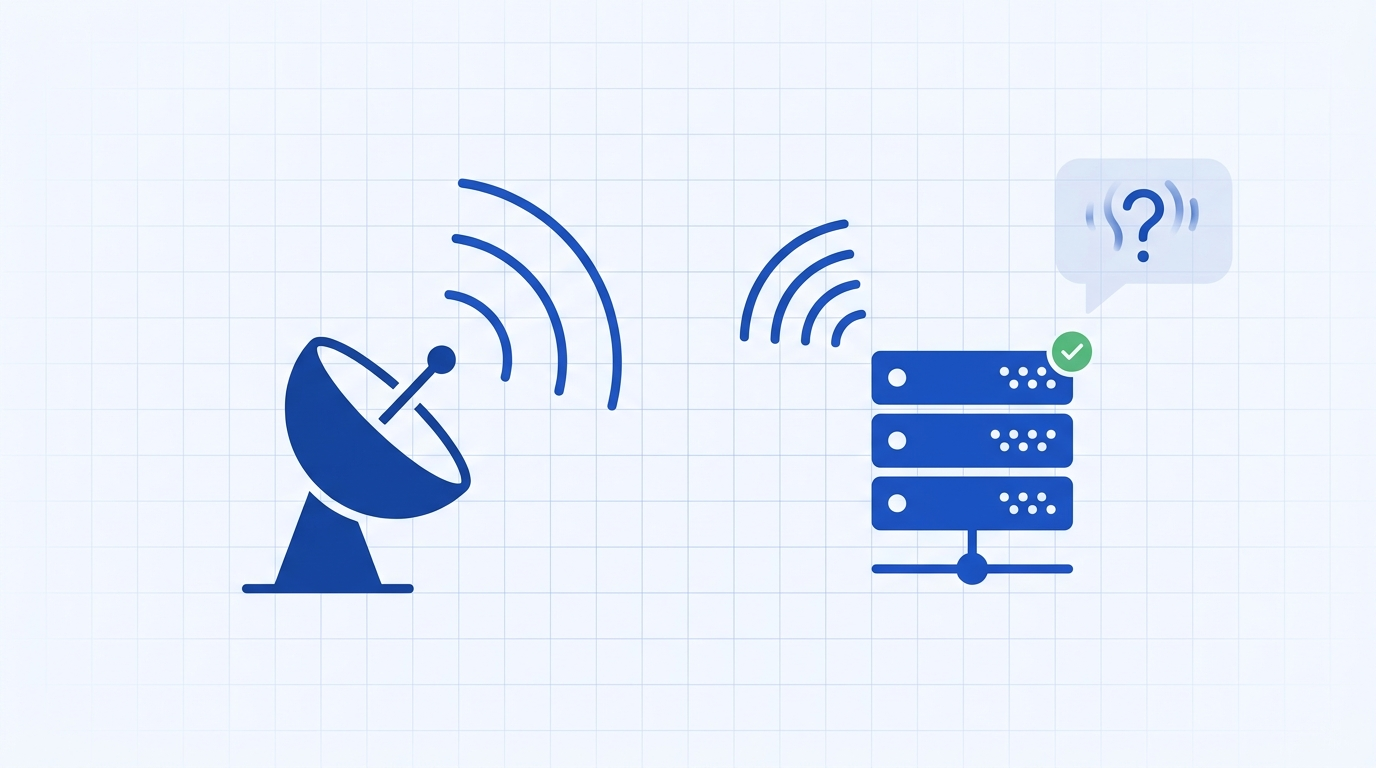
Uptime monitoring is the practice of having a system outside your infrastructure repeatedly ask "are you there?" and recording the answer. Everything else is detail about how you ask, how you judge the answer, and what you do when it is wrong.
The mechanics of a single check
A check runs on a schedule. At each interval the monitoring system resolves your hostname, opens a connection, negotiates TLS if needed, sends a request, waits until a timeout expires, and evaluates what came back. A check can pass or fail on the status code, on the presence of specific text in the body, on headers, or simply on whether a connection could be established. Only after retries are exhausted does the state change and an incident open.
What a passing check actually proves
At a specific moment, from one specific network location, a request for one specific URL returned a response matching your criteria within your timeout. That is genuinely valuable — it exercises DNS, routing, TLS, the load balancer, the application and often the database. But note the qualifiers: one moment, one location, one URL. Your homepage can be perfectly healthy while checkout is broken.
The health endpoint trap
A /health route that returns 200 from a static handler will stay green while your database is on fire. The resolution is two endpoints: a shallow liveness endpoint for the load balancer, and a deeper readiness endpoint for monitoring. Point your uptime monitor at the second one.
Interval, timeout and retries
Interval is your detection latency. Timeout defines what counts as too slow — set it near the edge of what your users would tolerate, not near the edge of what TCP allows. Retries are your defence against false alarms; two or three at a five second spacing is a sensible middle.
Reading an uptime percentage honestly
An uptime percentage is not a fact about your system, it is a fact about your measurements. Two teams running identical infrastructure can report 99.5% and 99.99% depending on what they check, how often, from where, and what they count as down. Publish the answers to those four questions alongside any number.
The relationship to the rest of monitoring
Uptime monitoring is deliberately shallow — a smoke detector, not a diagnostic tool. It does not replace metrics, tracing or logs, and it structurally cannot cover work that has no endpoint to poll, which is the domain of heartbeat monitoring. Its value is being the thing that wakes you up.